 Locked Lessons
Home › AP® Latin › Pliny, Letters 6.16
AP® Latin passage guide · Pliny, Letters 6.16
Pliny, Letters 6.16: The Death of Pliny the Elder
What happens
Tacitus has asked Pliny for an account of his uncle's death, for the history he is writing. Pliny agrees gladly: if Tacitus records it, his uncle will win lasting glory.
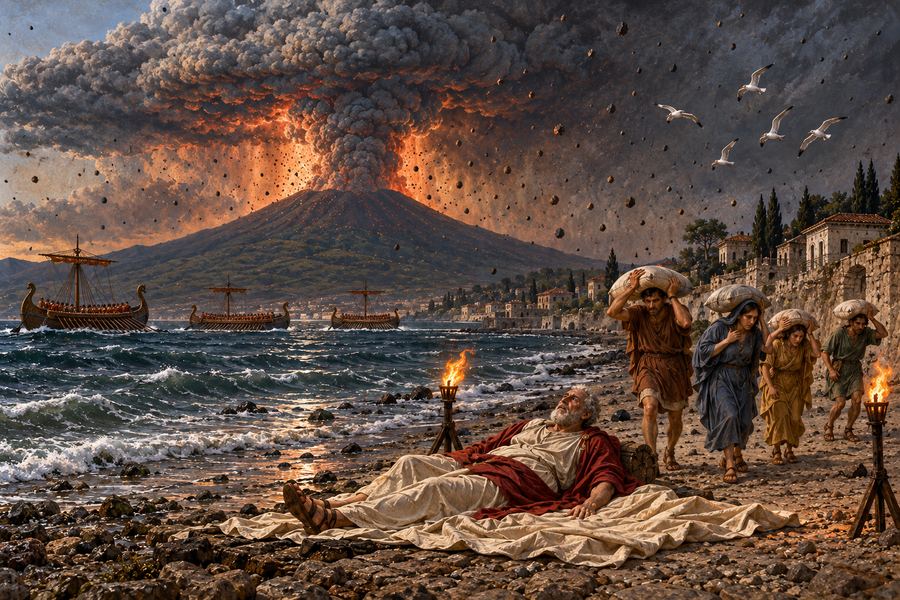
On 24 August AD 79 the elder Pliny, admiral of the fleet at Misenum, is shown a cloud of unusual size and shape rising over a mountain across the bay. It looks like an umbrella pine. He orders a fast ship to be made ready to take a closer look, but a note arrives from Rectina, whose villa lies under the mountain, begging to be rescued. He turns the scholar's outing into a rescue and sails straight towards the danger with the warships.
Ash and pumice fall on the ships and the shore is blocked, so he makes for his friend Pomponianus at Stabiae. There he bathes, dines cheerfully and even sleeps, to calm the others. As the courtyard fills with ash and the buildings shake, the household goes out with pillows tied to their heads against the falling stones. On the shore, under the fumes and flames, the old admiral collapses and dies. His body is found two days later, unharmed, looking more like a man asleep than dead.
Grammar to look for
- Indirect statement after verbs of seeing and saying: videō mortī eius sī celebrētur ā tē immortālem glōriam esse prōpositam, “I see that undying glory is in store for his death”
- Relative purpose clause with quō and a comparative: quō vērius trādere posterīs possīs, “so that you can hand it down more truly to future generations”
- Deponent verbs, passive in form and active in meaning: Ēgrediēbātur domō, “he was going out of the house”
- The historic present for vivid narrative: poscit soleās, ascendit locum, “he calls for his sandals, climbs to a spot”
- Gerundives used as adjectives: facere scrībenda aut scrībere legenda, “to do things worth writing about or to write things worth reading”
Style
- Simile: nōn alia magis arbor quam pīnus expresserit. The cloud is described through the shape of an umbrella pine, the image the letter is best known for.
- Chiasmus and antithesis: facere scrībenda aut scrībere legenda. The men of action and the men of letters are set against each other in mirror order; Pliny's uncle was both.
- Sententia: Fortēs inquit fortūna iuvat. The admiral's own proverb, the moment he decides to carry on.
- Paradox: quasi semper vīctūrus occiderit. He died as if he would live for ever, the theme of the whole letter.
Themes to think about
- How Pliny shapes the story to present his uncle as a hero, and where the letter hints at a different view
- Calm and courage in the face of disaster (the bath, the dinner, the sleep)
- Natural description: what Pliny saw and what he could only imagine
- Writing and immortality: glory through Tacitus' history
Practise this passage
The Cloud over Vesuvius is a self-grading escape room built from this passage's own vocabulary, with a grammar lock on deponent verbs in the present and perfect. It takes about one lesson.
Play the free taster (2 of 7 locks)About the room
More passage guides
- Pliny, Letters 6.20: Pliny's Escape from Misenum
- Pliny, Letters 7.27: The Haunted House
- Pliny, Letters 10.37 and 10.90: The Aqueducts of Bithynia
- Pliny, Letters 10.5–7: A Favour for Pliny's Doctor
AP® and Advanced Placement® are registered trademarks owned by the College Board, which is not affiliated with Locked Lessons and does not endorse it or its escape rooms.