 Locked Lessons
Home › AP® Latin › Pliny, Letters 7.27
AP® Latin passage guide · Pliny, Letters 7.27
Pliny, Letters 7.27: The Haunted House
What happens
Pliny asks his learned friend Sura whether ghosts are real, with a shape and power of their own, or empty images made by our fear. He tells three stories.
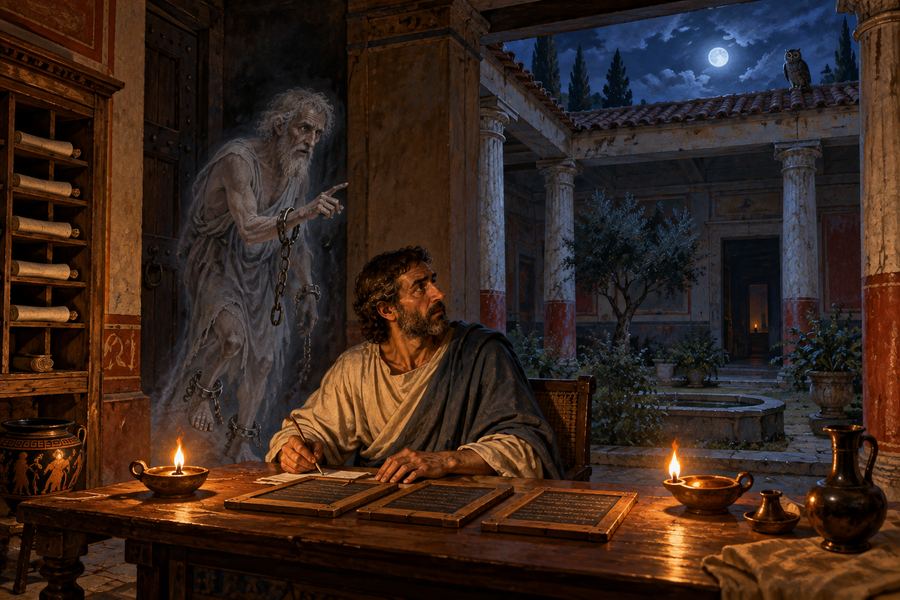
First, Curtius Rufus, a young man serving in Africa, meets a superhuman female figure who foretells his career; it all comes true, even his death. Second, the famous story: a large house in Athens is haunted by an old man, thin and filthy, with a long beard and wild hair, rattling the chains on his feet and hands. No one will live there, until the philosopher Athenodorus rents it cheaply. He sits writing through the night so that his mind will not invent phantoms; the ghost appears, beckons him, leads him to the courtyard and vanishes. When the spot is dug up, bones wrapped in chains are found; they are buried, and the house is quiet from then on.
Third, closer to home: Pliny's freedman and a slave boy wake to find their hair cut by mysterious visitors. Pliny later reads this as a sign that he escaped prosecution under Domitian. He closes by begging Sura to argue the question fully, but to give a definite answer.
Grammar to look for
- Indirect question: putēs an inānia et vāna ex metū nostrō imāginem accipere, “whether you think they are empty and unreal and take their shape from our fear”
- Historic infinitives: concutī ferrum, vincula movērī, “iron began to clank, chains to move”
- Indirect command with ut: monet ut illum locum effodī iubeant, “he advises them to order that spot to be dug up”
- Ablatives of description: prōmissā barbā horrentī capillō, “with a long beard and bristling hair”
Style
- Asyndeton: poscit pugillārēs stilum lūmen. The quick list shows a calm, businesslike philosopher.
- Tricolon: ad scrībendum animum oculōs manum intendit. Mind, eyes and hand all bent on writing.
- Chiasmus: cruribus compedēs, manibus catēnās. Shackles on the legs, chains on the hands.
- Climax: iam ut in līmine, iam ut intrā līmen audīrī. The noise draws nearer step by step.
Themes to think about
- Belief and scepticism: how Pliny arranges three stories from hearsay to his own household
- The philosopher's calm as a model of Roman self-control
- Proper burial and the restless dead
- Dreams, omens and politics under Domitian
Practise this passage
The Haunted House is a self-grading escape room built from this passage's own vocabulary, with a grammar lock on present, perfect and future infinitives. It takes about one lesson.
Play the free taster (2 of 7 locks)About the room
More passage guides
- Pliny, Letters 6.16: The Death of Pliny the Elder
- Pliny, Letters 6.20: Pliny's Escape from Misenum
- Pliny, Letters 10.37 and 10.90: The Aqueducts of Bithynia
- Pliny, Letters 10.5–7: A Favour for Pliny's Doctor
AP® and Advanced Placement® are registered trademarks owned by the College Board, which is not affiliated with Locked Lessons and does not endorse it or its escape rooms.