 Locked Lessons
Home › Guides › Teaching the Iliad and the Odyssey
Teaching guide
Teaching Homer's Iliad and Odyssey in translation
The Iliad and the Odyssey stand at the beginning of Western literature, and students who know them well will hear their echoes in Virgil, Dante, Shakespeare and much else. They are long poems, though, crowded with names, and a class can easily lose its way. This guide offers a plan for teaching both in English translation, in manageable sections.
Which poem first?
Either can come first. The Odyssey is often easier to start with: one hero, a journey, monsters and a homecoming. The Iliad is darker and more concentrated, the story of a few weeks of a long war and of one man's anger. Many teachers start with the Odyssey in the middle-school years and return to the Iliad in high school; others read them in order. The rooms on the site suit students from about grade 7.
Choosing a translation
The main choice is between translations that keep a line-by-line verse form and those that read more freely. Richmond Lattimore is close and literal; Robert Fagles and Robert Fitzgerald are freer and more fluent; Stanley Lombardo is fast and plain; Emily Wilson's versions are clear and keep to the original line count. Choose one that your students can read aloud with pleasure, and that has line numbers if you want to cite passages. The rooms ask about people, places and events rather than a translator's wording, so they work with any of these.
A plan in six sections
Both poems have twenty-four books, which divide neatly into six sections of four:
- Iliad: the quarrel of Achilles and Agamemnon (1–4); battle and Hector's farewell (5–8); the embassy to Achilles (9–12); the fight at the ships and the death of Patroclus (13–16); Achilles' return (17–20); the death of Hector and Priam's ransom (21–24).
- Odyssey: Telemachus and the suitors (1–4); Calypso and the Phaeacians (5–8); Odysseus' own tales of the Cyclops, Circe, the dead and the Sirens (9–12); home in disguise (13–16); the beggar in the palace (17–20); the bow, the suitors and the reunion (21–24).
Each section has its own self-checking escape room, which makes a natural checkpoint before you move on.
Keeping track of the names
Homer's names can overwhelm a class: heroes are called by their father's names, gods take sides and change shape, and minor warriors die by the dozen. Keep a running chart with three columns: Greeks, Trojans and gods, adding to it as you read. Teach the common epithets early, so that students recognise a character by description. The who's-who and make-the-pairs locks in each room practise exactly this.
Questions worth asking
Each poem rewards a few big questions returned to throughout. In the Iliad: what does honour require, and what does it cost? Why does Achilles finally relent in Book 24? In the Odyssey: what makes a good host or a good guest? Is Odysseus' cleverness admirable? What does homecoming mean for Penelope and Telemachus as well as for him?
The gods in Homer
Students are often puzzled by Homer's gods, who take sides, quarrel, deceive and rescue their favourites. It helps to track which gods support which side in the Iliad: Hera, Athena and Poseidon favour the Greeks; Apollo, Aphrodite and Ares favour the Trojans; Zeus holds the balance. In the Odyssey, Athena guides Odysseus and Telemachus while Poseidon pursues Odysseus for blinding his son the Cyclops. Ask students whether the gods' involvement makes the human choices in the poems matter less, or more.
Reading aloud and writing
Homer's poems were composed to be heard, and they come alive when read aloud. Give students a passage each, such as the parting of Hector and Andromache in Book 6 or Odysseus in the Cyclops' cave in Book 9, to prepare and perform. Listening also helps students notice the repeated phrases and epithets that hold the poems together.
For writing, short pieces after each section work well: a speech from one character to another, a comparison of two heroes, or a paragraph on how a guest is treated in a particular house. At the end, students can choose one of the big questions for a longer essay, drawing on the notes they have kept throughout.
With younger students
Younger children can meet the stories first in myth: the Greek heroes rooms are written for grades 4–6. Students reading the poems in Greek, or Virgil's answer to Homer, will find more under Greek and in the guide to teaching the Aeneid. Every room has free taster locks that anyone can try with a class, with no sign-up. Members get all seven locks of every room and a private class link to share.
Rooms to try
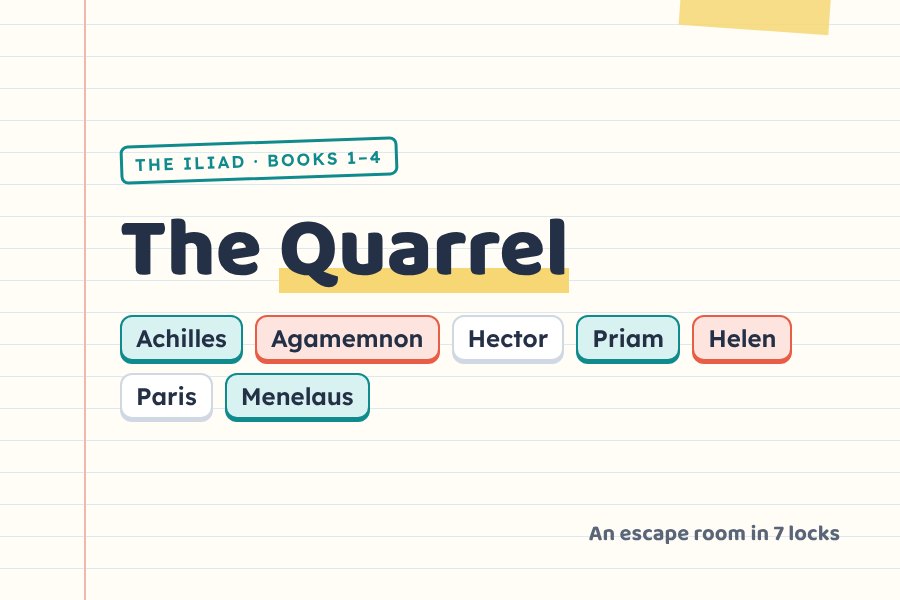 The Iliad · Books 1–4The QuarrelFree taster
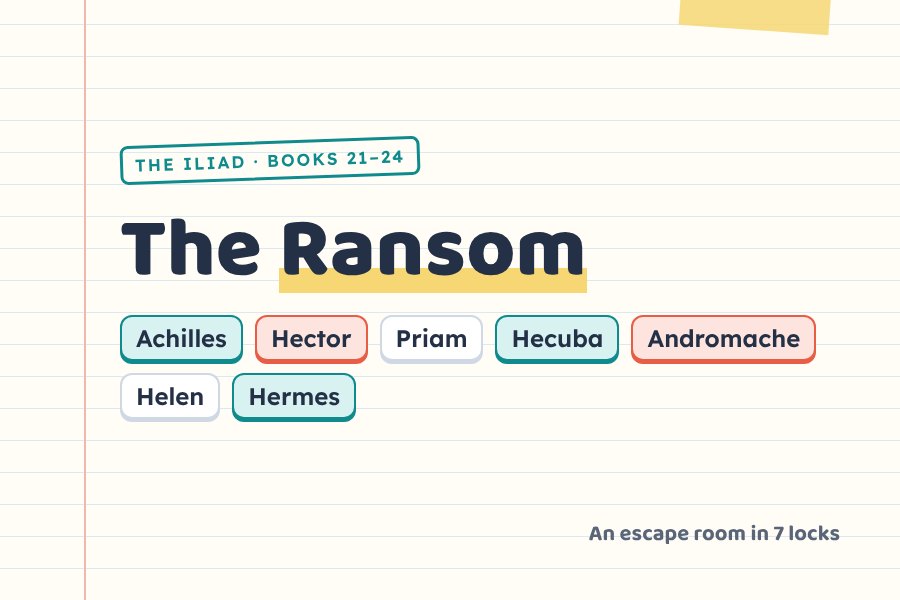 The Iliad · Books 21–24The RansomFree taster
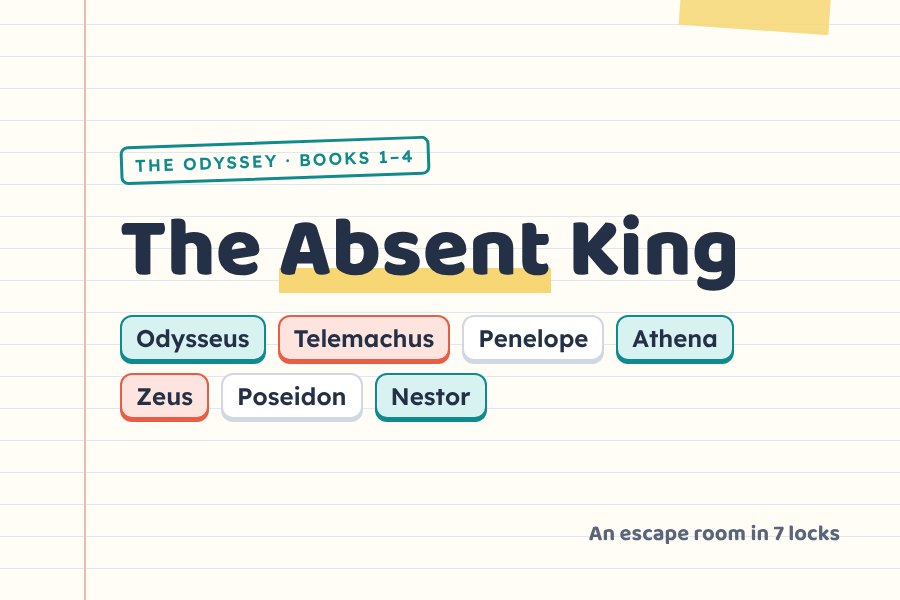 The Odyssey · Books 1–4The Absent KingFree taster
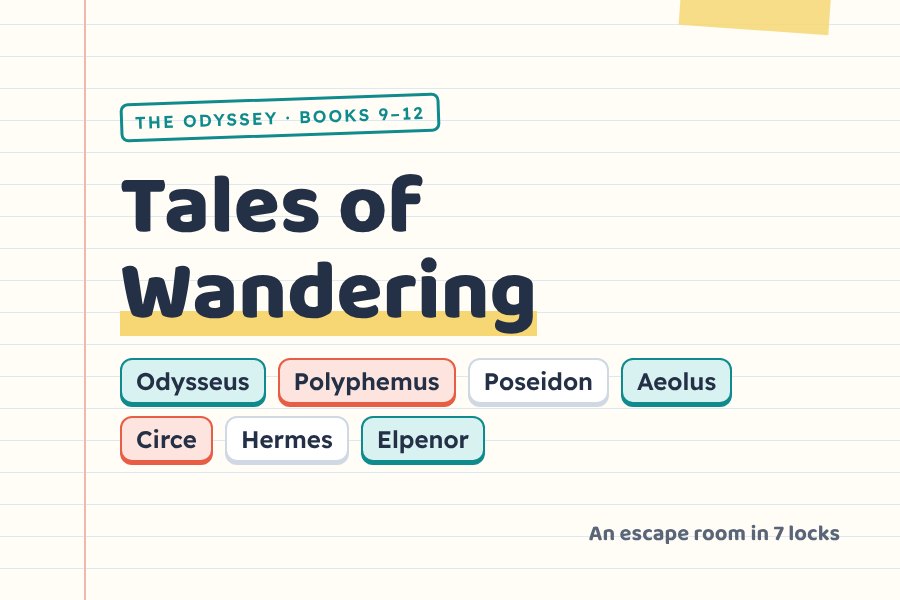 The Odyssey · Books 9–12Tales of WanderingFree taster
 The Odyssey · Books 21–24The Last ContestFree taster
 Greek Myths: The Heroes · PerseusThe Gorgon's GazeFree taster
Questions
Which translation of Homer should I use?
Any that your students can read with pleasure. Lattimore is close and literal; Fagles, Fitzgerald and Lombardo are freer; Wilson is clear and line for line. The escape rooms work with all of them.
What age should students read the Iliad and the Odyssey?
The full poems in translation suit students from about grade 7, often the Odyssey first. Younger children can meet the same stories through retellings of the myths.
How much should students read at a time?
Four books is a good section: it gives six sections for each poem, with a check at the end of each.
More guides
- Teaching Virgil's Aeneid in translation
- Greek and Roman mythology for elementary and middle school
- Rhetoric-stage great books for grades 9–12
- All teaching guides
Translators and editions are named only to show that the rooms work with any of them; Locked Lessons is not affiliated with them or their publishers.