 Locked Lessons
Home › Guides › Greek and Roman mythology, grades 4–8
Teaching guide
Greek and Roman mythology for elementary and middle school
Greek and Roman myths are some of the best stories children can hear, and they are everywhere: in poetry and paintings, in the names of planets and products, and in words like panic and cereal. Children who know them early will find Homer, Virgil and Shakespeare far easier later on. This guide suggests an order for teaching myth from grade 4 to grade 8, and some ways to make it stick.
Why myths early
Myths suit the grammar stage perfectly: they are short, vivid and full of names to remember. They also build the background later study depends on. A student who knows the judgement of Paris and the wooden horse will follow the Iliad and the Aeneid; one who knows Pyramus and Thisbe will laugh in the right places in A Midsummer Night's Dream.
Start with the gods
Begin with the Olympians, who they are, what they rule and how they are related, and with their Roman names, which children meet constantly: Zeus and Jupiter, Hera and Juno, Poseidon and Neptune, Athena and Minerva, Ares and Mars, Aphrodite and Venus, Hermes and Mercury, Artemis and Diana, Hephaestus and Vulcan, Demeter and Ceres, Dionysus and Bacchus, Hades and Pluto. Apollo keeps the same name in both. A family tree on the wall, filled in as the stories are told, keeps them straight. The Greek gods rooms are written for grades 4–6.
Then the heroes
The heroes come next: Perseus and Medusa, Theseus and the Minotaur, the labours of Heracles, Jason and the Golden Fleece, and the stories of Troy and Odysseus. Heroic stories have a clear shape, a task, a journey, monsters and a return, which children can map and compare. The Greek heroes rooms cover them for grades 4–6, and they lead naturally into Homer in later years.
The legends of Rome
From about grade 5, add the legends the Romans told about themselves: Aeneas' journey from Troy, Romulus and Remus, Horatius holding the bridge, Cincinnatus leaving his plough. They are less fantastic than the Greek myths, but they show children what the Romans admired, and they make a good companion to a first year of Latin. The legends of early Rome rooms are for grades 5–8.
Telling and retelling
Myths were told aloud long before they were written down, and they are still best heard. Read a myth aloud, then ask a child to retell it; next time, ask them to tell it from another character's point of view, such as Medusa's or the Minotaur's. Children quickly notice that the same story can be told in different ways, and that the ancient writers themselves disagreed about the details, which is a good first lesson in reading sources. Drawing a scene, acting a story out, or making a comic strip of a hero's adventure all help the names and events stay in memory.
Handling the darker stories
Myths are full of violence, cruelty and the misbehaviour of gods. Choose versions that suit the age of your class, and do not be afraid to leave some stories until later. The mythology rooms tell the standard ancient versions in their own words, with content chosen to suit each grade, so they work alongside whichever book of myths your class reads.
Myth and Latin
Myth and Latin support each other. Many first-year Latin courses tell stories about the gods and about Rome, and children who already know the myths enjoy recognising them in Latin. The names of the gods are also some of the first Latin words children meet: Jupiter, Juno, Neptune, Mars and Venus are the Latin names. If your children will start Latin later, a year of myths first gives them a store of names and stories to draw on, and the guide to starting Latin describes what comes next.
Beyond the book
Myth connects to everything. Map the heroes' journeys. Hunt for words that come from myth: panic from Pan, cereal from Ceres, volcano from Vulcan, museum from the Muses, atlas and echo from the figures of those names; the roots guide takes this further. High school students can go to the sources in Hesiod and Ovid with the Hesiod and Metamorphoses rooms. All the rooms are on the mythology page. Every room has free taster locks that anyone can try with a class, with no sign-up. Members get all seven locks of every room and a private class link to share.
Rooms to try
 Greek Myths: The Gods · The Titans and the OlympiansWar in the HeavensFree taster
 Greek Myths: The Gods · Prometheus and PandoraThe Stolen FlameFree taster
 Greek Myths: The Heroes · PerseusThe Gorgon's GazeFree taster
 Greek Myths: The Heroes · TheseusInto the MazeFree taster
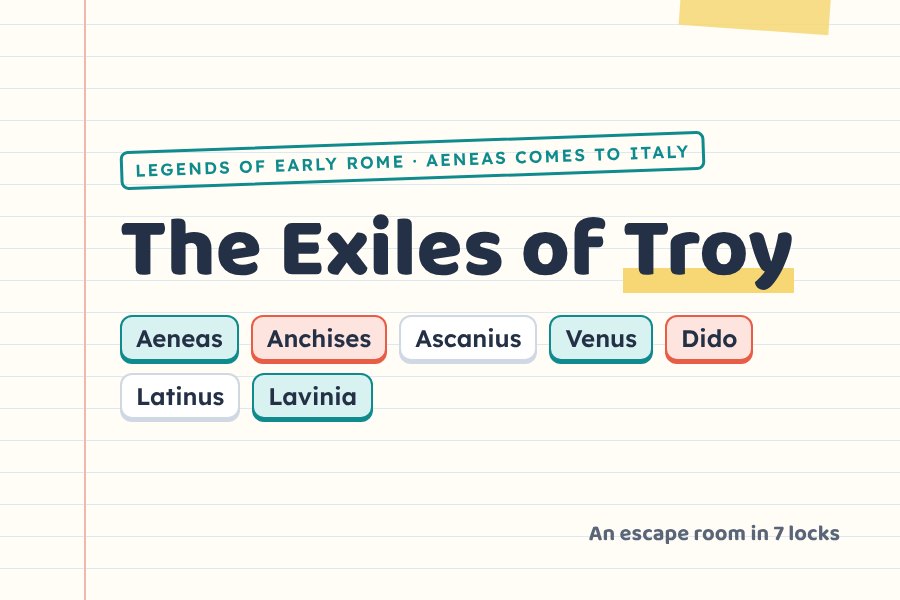 Legends of Early Rome · Aeneas Comes to ItalyThe Exiles of TroyFree taster
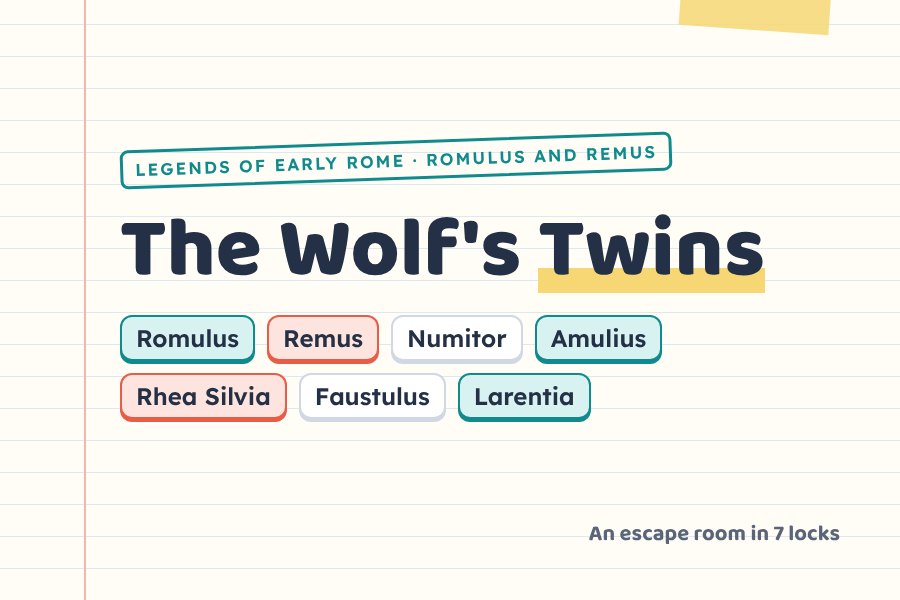 Legends of Early Rome · Romulus and RemusThe Wolf's TwinsFree taster
Questions
What age should children start Greek mythology?
Most children can enjoy the myths from about grade 3 or 4, read aloud or alone. The gods and heroes rooms are written for grades 4–6, and the legends of early Rome for grades 5–8.
Should I teach the Greek or the Roman names of the gods?
Both. Start with the Greek names for the Greek stories, and teach the Roman names alongside them, since children meet both in books, art and the names of the planets.
Which book of myths do the rooms follow?
None in particular. They tell the standard ancient versions of the myths in their own words, so they work alongside any book of myths, or the ancient texts for older students.