 Locked Lessons
Home › Guides › Teaching Greek and Latin roots
Teaching guide
Teaching Greek and Latin roots for vocabulary
A large part of English vocabulary, and much of the vocabulary of science and academic writing, is built from Latin and Greek roots. A student who knows that spect means look and graph means write has a key to hundreds of words they have never been taught. This guide covers which roots to start with, routines that make them stick, and the traps to watch for.
Why teach roots
Learning words one at a time is slow. Learning the parts they are made from lets students work out new words for themselves: inspect, spectator, spectacles and retrospect all open with one root. Roots also help with spelling, because they explain why words are spelled as they are, and they give students a way into the technical vocabulary of science, medicine and law.
Which roots first
Start with roots that turn up in many everyday words. From Latin: port (carry), dict (say), spect (look), struct (build), rupt (break), scrib and script (write), aud (hear), vid and vis (see), mit and miss (send), duc and duct (lead). From Greek: graph (write), phon (sound), tele (far), scope (look at), bio (life), geo (earth), chron (time), auto (self), photo (light) and micro (small). Older students can move on to less common roots and to the vocabulary of particular subjects.
Prefixes and suffixes
Roots work with prefixes and suffixes. A handful of prefixes, such as pre-, re-, sub-, inter-, trans- and con-, and suffixes such as -ology, -ible and -ion, multiply the words a student can unpick. Teaching students to take a long word apart, prefix, root and suffix, and put the meaning back together is the core skill.
Little and often
A few roots, met repeatedly, are worth more than a long list met once. Introduce two or three roots at a time, collect words that use them on a wall or in a notebook, and come back to them every week. Word sorts, where students group words by root, and word building, where they combine two roots to fit a definition, keep the practice active. When a new word turns up in reading, ask students to take it apart before reaching for a dictionary.
Roots across the curriculum
Roots are not only for English lessons. Science is full of them: photosynthesis, thermometer, hydrogen and biology all come apart into Greek pieces. Mathematics has polygon, perimeter and equilateral; history and civics have democracy, monarchy and legislature. When a new technical word comes up in any subject, take a minute to break it into its parts. Students begin to see that hard words are usually made of easy pieces, and that confidence carries into their reading in every subject.
Watch for false friends
Not every word that looks as if it contains a root really does. Pedal and pedestrian come from the Latin for foot, but pedagogue and paediatrician come from the Greek for child. Teaching students to check, rather than guess, is part of the skill. The odd-one-out lock in each roots escape room is built around this: in each row students must find the word that only looks as if it has the root.
Checking what has stuck
The real test of roots teaching is whether students use it on words they have not met. Every so often, give them a handful of unfamiliar words built from roots they know, such as audiometer, chronograph or introspection, and ask them to work out a meaning and explain how they got there. A sensible guess with good reasoning is a success, even if the dictionary adds a detail. Over time, students who do this routinely become noticeably bolder with long words in their reading.
Escape rooms by grade
The roots rooms come in bands: grades 4–5, grade 6, grade 7, grade 8 and grades 9–12, with four rooms in each. Each room is a mystery solved through seven locks: a crossword of words built from the room's roots, scrambled roots, a secret message, matching roots to meanings, building words from two roots, an odd one out, and a last lock where two earned roots crack the case. They suit English and vocabulary lessons, and Latin and Greek classes, where they link the words students are learning to their English descendants; see also the guide to starting Latin. Every room has free taster locks that anyone can try with a class, with no sign-up. Members get all seven locks of every room and a private class link to share.
Rooms to try
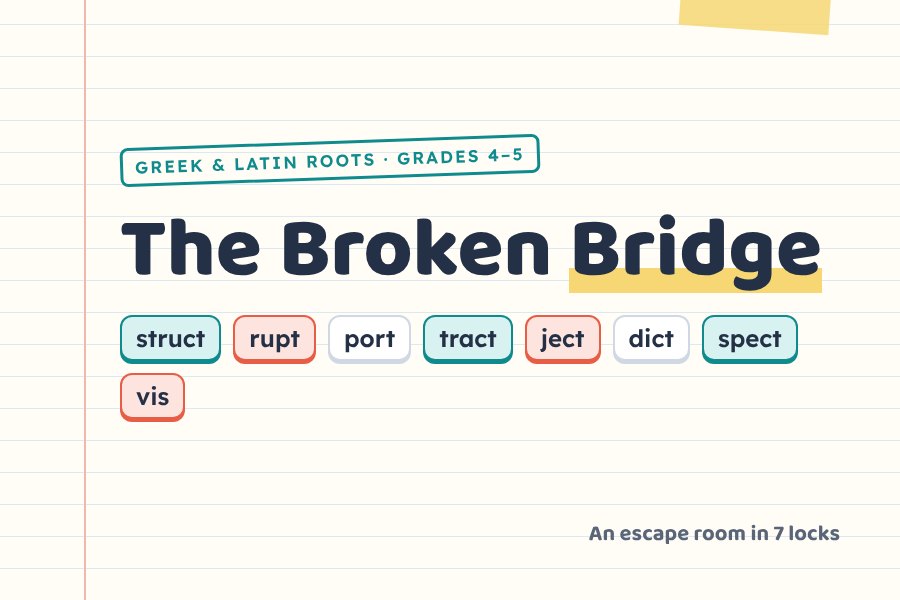 Grades 4–5 · RootsThe Broken BridgeFree taster
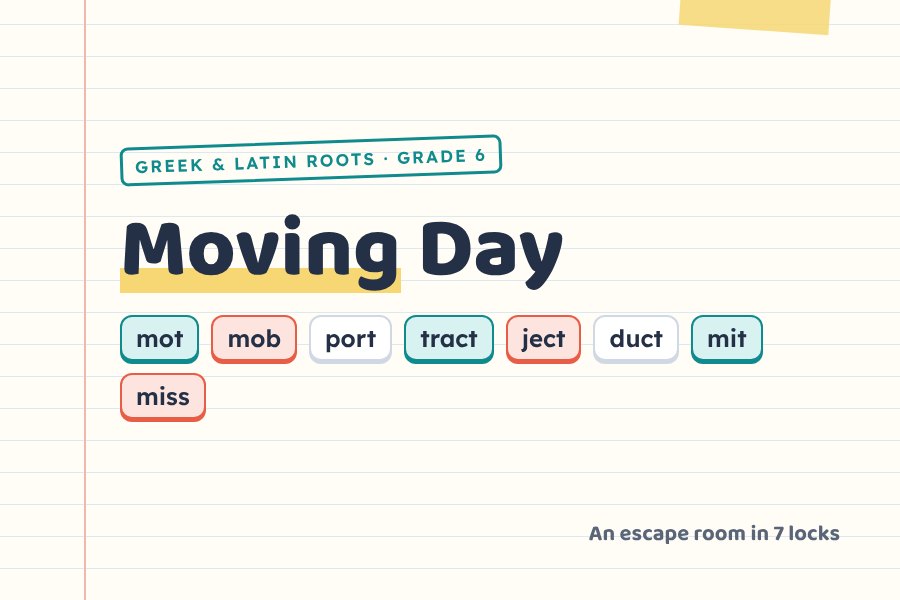 Grade 6 · RootsMoving DayFree taster
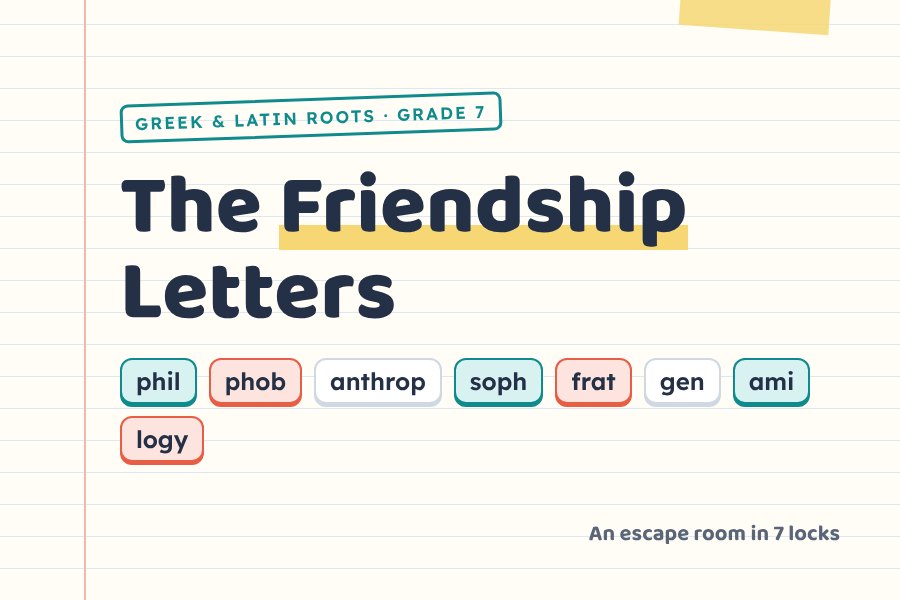 Grade 7 · RootsThe Friendship LettersFree taster
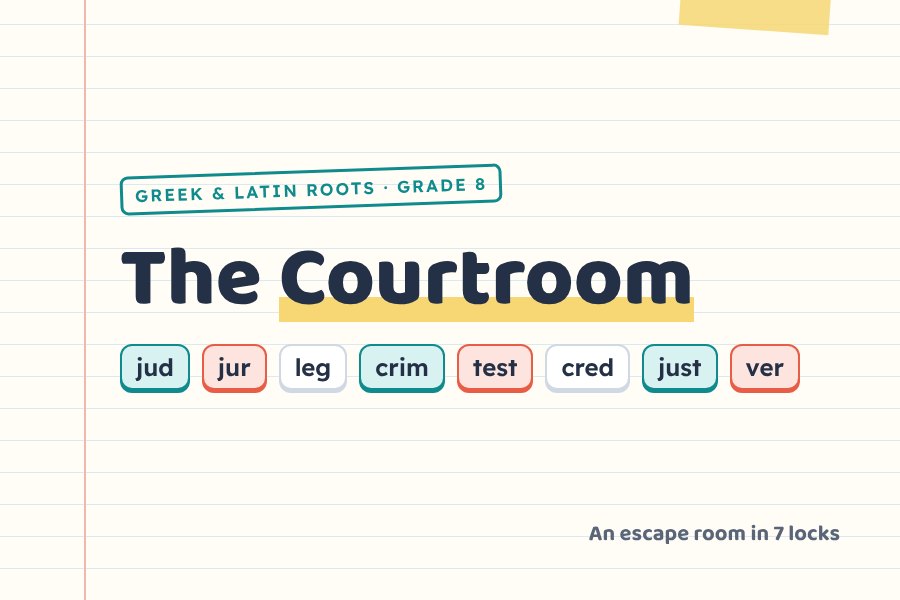 Grade 8 · RootsThe CourtroomFree taster
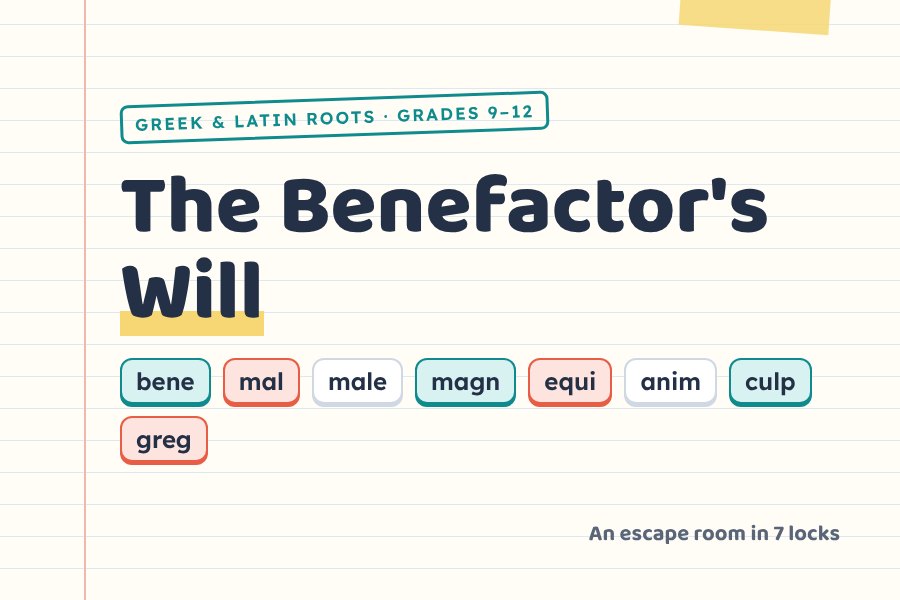 Grades 9–12 · RootsThe Benefactor's WillFree taster
Questions
What grade should students start learning Greek and Latin roots?
Grade 4 is a good time to start with common roots such as port, spect, graph and tele. The work deepens through middle school, and high school students can move on to the vocabulary of particular subjects.
Are roots for English or for Latin classes?
Both. Roots are a core part of English vocabulary teaching, and in Latin and Greek classes they connect the words students learn to English derivatives.
How many roots should students learn at a time?
A few at a time, revisited often, works better than a long list met once. Two or three new roots a week, with regular review, is a manageable pace for most classes.