 Locked Lessons
Home › Guides › Starting Latin
Teaching guide
Starting Latin: what a first year looks like
Starting Latin is exciting and, for a teacher or parent new to it, a little daunting. What should students know by the end of the first year? How much grammar, how many words, how much reading? This guide describes what a typical first year covers, the habits that matter most, and how to keep review going so that the early material is still there in the spring.
What a first year covers
Courses differ in order and pace, but most first years cover similar ground. Students learn to pronounce Latin and to read it aloud. They learn that Latin nouns change their endings to show their job in the sentence, starting with the subject and the object (the nominative and accusative cases) and adding others through the year. They meet the first declensions and the main verb conjugations, the present tense and at least one or two past tenses, and a core vocabulary of a few hundred words. Above all they begin to read: short sentences at first, then connected stories.
Reading-first or grammar-first
Some courses lead with stories and let grammar emerge from them; others teach forms and rules first and read afterwards. Both work, and good teachers borrow from each. Reading courses give students more Latin to read early on; grammar-first courses give them firmer tables. Whichever you use, make sure students both read Latin and learn the forms, since each supports the other.
The habits that matter most
Little and often beats long and rare. A few minutes of vocabulary every day, saying endings aloud, reading the week's Latin a second time, and spotting English derivatives (the roots guide has more on this) will do more than an occasional long session. Ask students to read Latin aloud before translating it, so that they take it in as language and not as a code.
A typical week
A first-year week might include a new piece of grammar introduced with examples, a short story or set of sentences to read and translate, daily vocabulary practice, and one lesson given over to review. In a homeschool that might mean half an hour a day; in a school, three to five lessons. Keep a written record of new endings and words in one notebook, so students can look back at what they have learned. Most of all, keep reading: the more Latin students see, the more the forms start to feel familiar.
Where review falls apart
The difficulty with a first year is not learning each new thing, but keeping hold of the old ones. Endings learned in September blur by December. Planned review, coming back to earlier material at regular intervals, is the remedy, and it is easiest when it comes with a natural occasion.
How escape rooms help with review
The Latin escape rooms come in seasonal sets, from Halloween, Thanksgiving and Christmas to Valentine's Day, St Patrick's Day, Easter and the end of the year, each with a room for every level. A Latin I room reviews the vocabulary and grammar of the first year so far. Its seven self-checking locks include a crossword, anagrams, a cipher, verb-form matching, a picture count, an odd-one-out story and a final rebus that draws on all the others. Students do not need to type macrons. Each room takes about one lesson, and progress is saved in the browser if it runs over.
A good first room is Escape from Pompeii, a Latin I room set at the end of the year. The Latin I to IV rooms are written to match the books of the Cambridge Latin Course, and each room page names the stages it uses; classes on other courses can choose rooms by year. Locked Lessons is independent and is not affiliated with or endorsed by the publishers of the Cambridge Latin Course (Cambridge University Press) or Athenaze (Oxford University Press); the course names are used only to show which rooms fit which books.
Starting at home
Parents who did not learn Latin themselves can still teach it, especially with a course that has a teacher's guide; many parents learn alongside their children. The self-checking rooms help here too, because you do not need to know every answer to know that your child has found it. Every room has free taster locks that anyone can try with a class, with no sign-up. Members get all seven locks of every room and a private class link to share.
After the first year
The rooms continue through Latin II, Latin III and Latin IV to the AP® Latin readings from Pliny and Vergil, and there are Classical Greek rooms for beginners for those who want to add a second ancient language.
Rooms to try
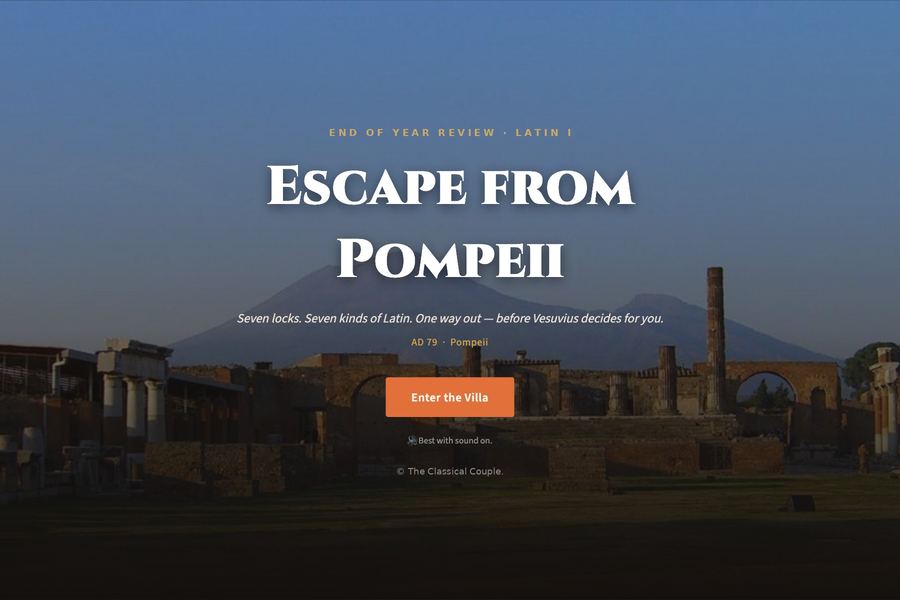 Latin I · End of YearEscape from PompeiiFree taster
 Latin I · Back to SchoolThe First Day at SchoolFree taster
 Latin I · HalloweenNight of Household SpiritsFree taster
 Latin I · Election DayVote for Holconius!Free taster
 Latin I · Veterans DayThe Old SoldierFree taster
 Latin I · ThanksgivingThe Feast of ThanksFree taster
Questions
What age should children start Latin?
There is no single right age. Many classical schools and homeschools start a gentle course somewhere between grades 3 and 6; others begin in middle or high school. What matters most is steady, regular practice.
Do students have to type macrons in the Latin rooms?
No. Macrons are never needed: answers are accepted without them.
Which Latin textbook do the rooms work with?
The Latin I to IV rooms are written to match the Cambridge Latin Course, Books 1 to 4, and each room page names the stages it uses. Classes on other courses can choose rooms by year.
More guides
- Teaching Greek and Latin roots for vocabulary
- Escape rooms for a classical education
- How to use digital escape rooms in a homeschool
- All teaching guides
AP® and Advanced Placement® are registered trademarks owned by the College Board, which is not affiliated with Locked Lessons and does not endorse it or its escape rooms.