 Locked Lessons
Home › AP® Latin › Vergil, Aeneid 2.40–56 and 201–249
AP® Latin passage guide · Vergil, Aeneid 2.40–56, 201–249
Vergil, Aeneid 2.40–56 and 201–249: Laocoön and the Wooden Horse
What happens
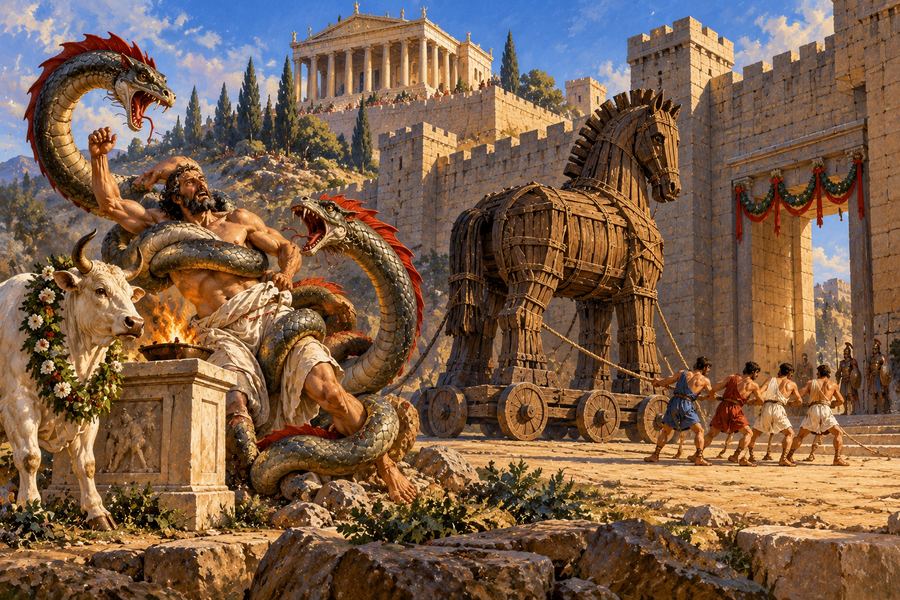
Aeneas tells Dido the story of Troy's fall. The Trojans are arguing over the wooden horse left on the shore when the priest Laocoön runs down from the citadel. Do you think the enemy has sailed away? Is this how you know Ulysses? Either Greeks are hidden inside, or it is a war machine to spy on the city. 'I fear the Greeks, even when they bring gifts.' He hurls his spear into the horse's side, and the hollow belly booms.
Later, as Laocoön sacrifices a bull to Neptune, two huge serpents swim across from Tenedos, land, and seize first his two small sons and then the priest himself, coiling round him while he roars like a wounded bull at the altar. The snakes glide to Minerva's temple and hide under the goddess's shield.
The Trojans take this as punishment for striking the sacred horse. They breach their own walls and drag it in, with boys and girls singing hymns. Four times it halts at the gate, four times the arms clash inside, yet blind with madness they set it on the citadel. Even Cassandra's prophecies are not believed.
Grammar to look for
- The passive voice: sub pedibusque deae clipeīque sub orbe teguntur, “they are hidden beneath the goddess's feet and the round of her shield”
- Present participle used as a noun: timeō Danaōs et dōna ferentēs, “I fear the Greeks even when bringing gifts”
- Indirect statement: Crēditis āvectōs hostēs, “do you believe the enemy has sailed away?”
- Historic present: corripiunt, “they seize”
Style
- Rhetorical questions: Ō miserī, quae tanta īnsānia, cīvēs. Laocoön's outraged opening.
- Parenthesis: horrēscō referēns. Aeneas shudders as he tells the story.
- Simile: quālis mūgītūs, fūgit cum saucius āram taurus. The priest roars like the sacrificial bull.
- Anaphora and repetition: quater ipsō in līmine portae substitit. Four warnings at the gate, all ignored.
Themes to think about
- Deception and Greek cunning (Ulysses)
- Divine will: are the gods punishing Laocoön or destroying Troy?
- Aeneas as narrator and his grief
- Blindness and madness in the Trojan crowd
Practise this passage
Beware Greeks Bearing Gifts is a self-grading escape room built from this passage's own vocabulary, with a grammar lock on the passive voice. It takes about one lesson.
Play the free taster (2 of 7 locks)About the room
More passage guides
- Vergil, Aeneid 1.1–33: The Proem and Juno's Anger
- Vergil, Aeneid 1.88–107 and 496–512: The Storm and Dido
- Vergil, Aeneid 4.74–89 and 165–197: Dido's Love, the Cave and Fama
- Vergil, Aeneid 4.305–361: Dido and Aeneas Quarrel
- Vergil, Aeneid 6.450–476, 788–800 and 847–853: Dido's Shade and Rome's Mission
- Vergil, Aeneid 7.45–58 and 783–817: Latinus, Turnus and Camilla
- Vergil, Aeneid 11.532–594: Diana's Story of Camilla
- Vergil, Aeneid 12.791–828 and 919–952: Juno's Reconciliation and the Death of Turnus
AP® and Advanced Placement® are registered trademarks owned by the College Board, which is not affiliated with Locked Lessons and does not endorse it or its escape rooms.