 Locked Lessons
Home › AP® Latin › Vergil, Aeneid 4.74–89 and 165–197
AP® Latin passage guide · Vergil, Aeneid 4.74–89, 165–197
Vergil, Aeneid 4.74–89 and 165–197: Dido's Love, the Cave and Fama
What happens
Dido, wounded by love, leads Aeneas round her walls and shows him the wealth of Carthage. She begins to speak and stops mid-word. At dinner she asks again to hear of Troy's fall, and hangs on his words. When the guests have gone, she lies on the couch he has left; she sees and hears him though he is absent, or holds Ascanius in her lap to trick her love. The work on her city stops: the towers do not rise, the young men do not drill, the walls stand unfinished.
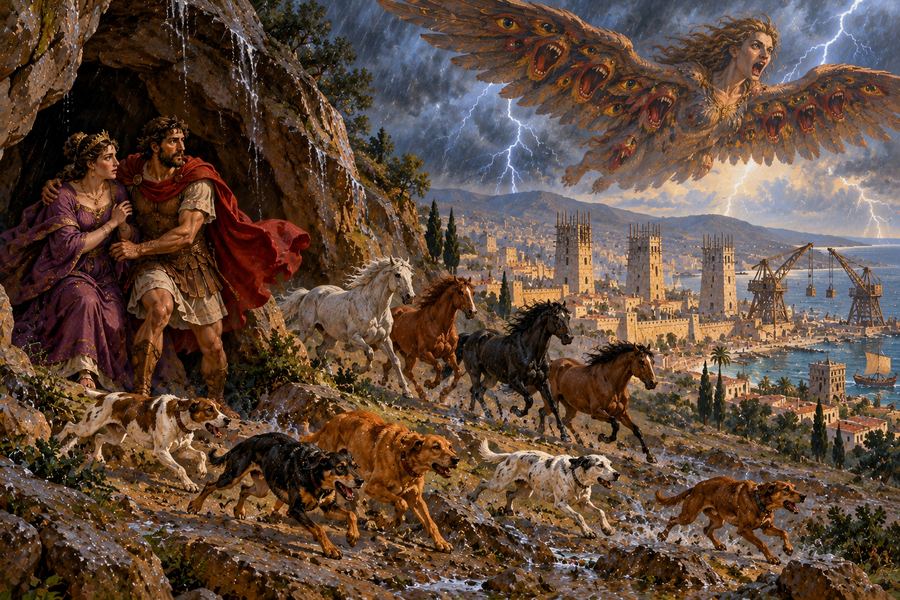
During a hunt, Juno sends a storm. Dido and the Trojan leader reach the same cave. Earth and Juno give the signal; lightning flashes and the nymphs wail on the mountain top. That day was the first cause of death and of disasters. Dido calls it marriage, and with that name covers her guilt.
At once Fama, Rumour, races through the cities of Libya: a monster that grows as it moves, with as many eyes, tongues and ears as feathers. She spreads the story that Dido and Aeneas have forgotten their kingdoms in luxury, and takes it to King Iarbas.
Grammar to look for
- Deponent verbs: incipit effārī mediāque in vōce resistit, “she begins to speak and stops mid-word”
- Subjunctive after sī meaning 'in the hope that': īnfandum sī fallere possit amōrem, “in the hope that she can cheat her unspeakable love”
- Relative pronoun as an ablative of comparison: quā nōn aliud vēlōcius ūllum, “than whom no other evil is swifter”
Style
- Hyperbaton: the cave frames the pair: Spēluncam Dīdō dux et Trōiānus eandem dēveniunt. The pair framed inside the cave.
- Personification: Extemplō Libyae magnās it Fāma per urbēs. Rumour as a living monster.
- Repetition of prīmus: ille diēs prīmus lētī prīmusque malōrum causa fuit. The poet's verdict on the wedding day.
- Pathetic fallacy: summōque ululārunt vertice Nymphae. The nymphs wail instead of singing a wedding hymn.
Themes to think about
- Love as wound and fire
- Culpa: what Dido's 'marriage' covers
- The city left unbuilt
- Rumour and reputation
Practise this passage
Love and Rumour is a self-grading escape room built from this passage's own vocabulary, with a grammar lock on deponent verbs. It takes about one lesson.
Play the free taster (2 of 7 locks)About the room
More passage guides
- Vergil, Aeneid 1.1–33: The Proem and Juno's Anger
- Vergil, Aeneid 1.88–107 and 496–512: The Storm and Dido
- Vergil, Aeneid 2.40–56 and 201–249: Laocoön and the Wooden Horse
- Vergil, Aeneid 4.305–361: Dido and Aeneas Quarrel
- Vergil, Aeneid 6.450–476, 788–800 and 847–853: Dido's Shade and Rome's Mission
- Vergil, Aeneid 7.45–58 and 783–817: Latinus, Turnus and Camilla
- Vergil, Aeneid 11.532–594: Diana's Story of Camilla
- Vergil, Aeneid 12.791–828 and 919–952: Juno's Reconciliation and the Death of Turnus
AP® and Advanced Placement® are registered trademarks owned by the College Board, which is not affiliated with Locked Lessons and does not endorse it or its escape rooms.